About Aluminum
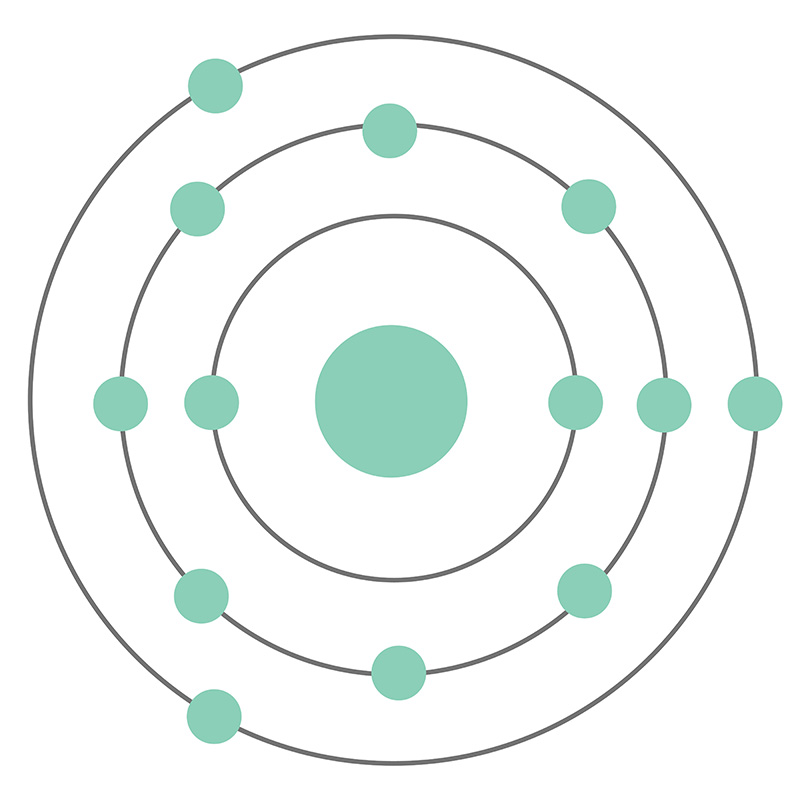
Compounds called alums--latin for “bitter salt”-- were used in dyes and wound dressings in ancient Greece and Rome. When the existence of a base metal of these salts was recognized in 1808 by Humphry Davy, he named it "alumium," which was eventually changed to "aluminum." Aluminum metal was first purified by another chemist in 1825, but it was initially very difficult to extract the metal from ore, and for some years this made pure aluminum very valuable. In the late 1880’s, two independent chemists developed what came to be known as the Hall-Heroult process for extracting aluminum from minerals, making extraction much more economical and bringing the metal into more general use.
Aluminum is the third most abundant element in the earth’s crust and the most abundant metal. As such, the element and its compounds have practically innumerable applications. The elemental metal is durable, lightweight, ductile, and malleable, and therefore can be easily formed using a variety of metalworking techniques. However, pure aluminum is soft and lacking in strength, and therefore alloys of aluminum with other metals are generally used for most applications--even household aluminum foil and aluminum beverage cans are generally produced from alloys. Aluminum alloys are generally less dense than alternative metals of similar strength, and thus are particularly useful in applications where a strong but lightweight structure is needed. These alloys are used in the construction of vehicles and buildings, and are frequently the casing material for small electronics. Additionally, aluminum is a component of the magnetic alloys MKM steel and Alnico, which are both used to produce permanent magnets for a variety of uses. Aluminum is also a good thermal and electrical conductor, leading it to find uses as heatsinks and wiring in electronics.
Aluminum oxide, often called alumina, is one of the most common aluminum compounds. Its crystalline form occurs naturally as corundum, high-quality forms of which are used as gemstones and considered either rubies or sapphires depending on the colors imparted by trace impurities. These gems are the hardest natural substances after diamond, and are therefore extremely resistant to scratching. Synthetic versions are used in optical devices such as spectroscopes and lasers, shatter resistant windows, and as insulating substrates for silicon integrated circuits. Powdered forms of aluminum oxide are used as filler in plastics, as it is both white and fairly chemically inert. The same properties lead to its use in sunscreens and cosmetic products. The powder is also used as an abrasive in industrial and commercial applications from sandpaper to toothpaste, and as a catalyst or catalyst support for some industrial chemical processes. Alumina may be used in the production of zirconia aluminia, an extremely strong and corrosion resistant class of composite ceramics that are used in cutting tools and medical implants. Finally, alumina fibers are components of many experimental and a few commercial fiber composite materials, and alumina nanofibers specifically have attracted a great deal of research interest.
Aluminum silicates are also aluminum compounds of considerable commercial importance. A number of aluminosilicates occur naturally, often as microporous minerals known as zeolites or hydrated clay minerals such as kaolin. Natural zeolites can be used industrially, but most applications use synthetic zeolites. Zeolites are notable for their very regular pore sizes, which allow them to act as molecular sieves, separating mixtures based on particle size.This property is exploited for applications in water purification, research chemistry, and the precise separation of gases from mixed gas streams. Additionally, the mineral’s porous nature allows it to filter select ions from nuclear waste, which can then be trapped permanently by pressing the mineral into a non-porous durable ceramic. Zeolites can also efficiently store heat, and are therefore used in heating, refrigeration, and energy storage applications. The high surface area provided by the porous material makes zeolites an excellent catalyst support material. Additionally, zeolites are used in laundry detergent, concrete and cement, medical applications, agriculture, and in aquarium filters and cat litter. Aluminosilicates are also frequently used to produce ceramics; notably, kaolin clay is the base material for the well-known ceramic porcelain.
There are many other notable aluminum compounds. Aluminum sulfates and alums are used in water treatment, paper manufacturing, fabric dying, fireproofing, and leather tanning. Aluminum chloride is used as a catalyst in oil refining and the production of synthetic rubber and polymers, while aluminum chlorohydrate is used in antiperspirants and in water treatment applications. Aluminum is a component of the semiconductor aluminum gallium arsenide, which is often used alongside gallium arsenide in semiconductor devices, and of antimony-aluminum phase change material used in phase-change memory devices. Lanthanum aluminate is a perovskite ceramic that is of interest for use as a substrate for the growth of superconducting thin-films, and as a gate dielectric for use in next-generation metal oxide semiconductor field-effect transistors (MOSFETs).
Aluminum has a strong affinity for oxygen and is therefore rarely found in its pure state in nature. It is instead found primarily as oxides and silicates, and the primary commercial ore of aluminum is a mix of minerals known as bauxite. The Hall-Heroult process developed in the 19th century is still used today for the processing of aluminum ore. The process requires a significant amount of energy input, but all proposed alternatives have either been less viable economically or were ruled out due to environmental concerns. Since aluminum can be recycled for a fraction of the energy cost of removing new aluminum from ore, aluminum recycling is cost effective and practiced widely. The “secondary” aluminum produced from recycling therefore accounts for a sizable percentage of the aluminum used each year. Additionally, a number of aluminum-containing minerals are mined for direct use or use as compounds, rather than for extraction of metallic aluminum.
Products
Aluminum is available as metal and compounds with purities from 99% to 99.9999% (ACS grade to ultra-high purity) in the form of foils, sputtering targets, and nanopowders. Elemental or metallic forms include pellets, rod, wire and granules for evaporation source material purposes. Aluminum oxide is available in forms including powders and dense pellets for such uses as optical coating and thin film applications.
  Aluminum is available in soluble forms including chlorides, nitrates and acetates. These compounds are also manufactured as solutions at specified stoichiometries. Aluminum may be synthesized in ultra-high purity (99.999+%) forms for laboratory standards, advanced electronic, thin film deposition using sputtering targets and evaporation materials, metallurgy and optical materials and other high technology applications. Organometallic aluminum compounds are soluble in organic or non-aqueous solvents. Information is provided for stable (non-radioactive) aluminum isotopes in the isotopes tab above. See Analytical Services for information on available certified chemical and physical analysis techniques including MS-ICP, X-Ray Diffraction, PSD and Surface Area (BET) analysis.
Aluminum Properties

 Aluminum, also known as Aluminium, is a Block P, Group 13, Period 3 element. It is the third most abundant element in the earth's crust and the most abundant metallic element. In its elemental form, CAS 7429-90-5, Aluminum has a silvery gray metallic appearance. Pure aluminum is soft and lacks strength, but alloyed with small amounts of copper, magnesium, silicon, manganese, or other elements it has extraordinarily useful properties.
  It is light, nonmagnetic and non-sparking. It is second among metals in the scale of malleability, and sixth in ductility. Metallic aluminum was first predicted to be a component of alum salts in 1808 by Humphry Davy, and was first isolated in pure form by Friedrich Wöhler in 1827.
Health, Safety & Transportation Information for Aluminum
Safety data for aluminum metal, nanoparticles, and compounds can vary widely depending on the form. For potential hazard information, toxicity, and road, sea and air transportation limitations, such as DOT Hazard Class, DOT Number, EU Number, NFPA Health rating and RTECS Class, please see the specific aluminum material or compound referenced in the “Products” tab. The below information applies to elemental (metallic) Aluminum.
| Safety Data | |
|---|---|
| Signal Word | Warning |
| Hazard Statements | H228 |
| Hazard Codes | F |
| Risk Codes | 11 |
| Safety Precautions | N/A |
| RTECS Number | BD0330000 |
| Transport Information | UN 1396 4.3/PG 2 |
| WGK Germany | nwg |
| Globally Harmonized System of Classification and Labelling (GHS) |
 |
Aluminum Isotopes
Aluminum has 22 known isotopes from 21Al to 42Al. Of the 22, only 27Al (stable isotope) and 26Al (radioactive isotope; t1/2 = 0.72x10⁶ yr) occur naturally. 26Al is produced from argon in the atmosphere by spallation caused by cosmic-ray protons. 26Al and 27Al have several practical applications; for example, dating of marine sediments, glacial ice, and meteorites. The ratio of 26Al to 10Be has been used to study the role of transport, deposition, sediment storage and burial times, and erosion on 105 to 106 yr timescales.
| Nuclide | Isotopic Mass | Half-Life | Mode of Decay | Nuclear Spin | Magnetic Moment | Binding Energy (MeV) | Natural Abundance (% by atom) |
|---|---|---|---|---|---|---|---|
| 21Al | 21.02804(32)# | <35 ns | p to 20Mg | 1/2+# | N/A | 128.98 | - |
| 22Al | 22.01952(10)# | 59(3) ms | ß+ to 22Mg; ß+ + 2p to 20Ne; ß+ + p to 21Na | (3)+ | N/A | 145.44 | - |
| 23Al | 23.007267(20) | 470(30) ms | ß+ to 23Mg; ß+ + p to 22Na | 5/2+# | N/A | 164.7 | - |
| 24Al | 23.9999389(30) | 2.053(4) s | EC + a to 20Ne; EC to 24Mg | 4+ | 3.646 | 180.23 | - |
| 25Al | 24.9904281(5) | 7.183(12) s | EC to 25Mg | 5/2+ | N/A | 196.7 | - |
| 26Al | 25.98689169(6) | 7.17(24)E+5 y | EC to 26Mg | 5+ | N/A | 208.5 | - |
| 27Al | 26.98153863(12) | STABLE | - | 5/2+ | 3.641504 | 221.24 | 100 |
| 28Al | 27.98191031(14) | 2.2414(12) min | ß- to 28Si | 3+ | 3.24 | 229.32 | - |
| 29Al | 28.9804450(13) | 6.56(6) min | ß- to 29Si | 5/2+ | N/A | 238.33 | - |
| 30Al | 29.982960(15) | 3.60(6) s | ß- to 30Si | 3+ | N/A | 244.54 | - |
| 31Al | 30.983947(22) | 644(25) ms | ß- to 31Si; ß- + n to 30Si | (3/2,5/2)+ | N/A | 251.69 | - |
| 32Al | 31.98812(9) | 31.7(8) ms | ß- to 32Si; ß- + n to 31Si | 1+ | N/A | 255.11 | - |
| 33Al | 32.99084(8) | 41.7(2) ms | ß- to 33Si; ß- + n to 32Si | (5/2+)# | N/A | 261.33 | - |
| 34Al | 33.99685(12) | 56.3(5) ms | ß- to 34Si; ß- + n to 33Si | 4-# | N/A | 263.82 | - |
| 35Al | 34.99986(19) | 38.6(4) ms | ß- to 35Si; ß- + n to 34Si | 5/2+# | N/A | 269.1 | - |
| 36Al | 36.00621(23) | 90(40) ms | ß- to 36Si; ß- + n to 35Si | N/A | N/A | 270.66 | - |
| 37Al | 37.01068(36) | 10.7(13) ms | ß- to 37Si | 3/2+ | N/A | 275.01 | - |
| 38Al | 38.01723(78) | 7.6(6) ms | ß- to 38Si | N/A | N/A | 276.57 | - |
| 39Al | 39.02297(158) | 7.6(16) ms | ß- to 39Si | 3/2+# | N/A | 279.99 | - |
| 40Al | 40.03145(75)# | 10# ms [>260 ns] | Unknown | N/A | N/A | 279.68 | - |
| 41Al | 41.03833(86)# | 2# ms [>260 ns] | Unknown | 3/2+# | N/A | 281.24 | - |
| 42Al | 42.04689(97)# | 1# ms | Unknown | N/A | N/A | 281.86 | - |