About Silicon
Silicon is truly ubiquitous, but is almost never found as the free element in nature. Instead, it occurs mostly as silicon dioxide, more commonly known as sand or quartz, or in silicate minerals, generally in the found in the forms of clay or rock. It was first proposed that silica sand was likely the oxide of a previously unknown element by Antoine Lavoisier in 1787. In 1808, Sir Humphry Davy named this hypothetical element “silicium”, combining the Latin silex, meaning stone, with the traditional -ium ending often given to metallic elements. The name was changed to silicon in 1817, as the -on ending suggested its closer relation to the non-metallic elements boron and carbon, but it wasn’t until 1823 that the Swedish chemist Jons Jacob Berzelius finally succeeded in preparing pure amorphous silicon and as the first to do so was given credit for “discovering” the element.
The vast majority of silicon used commercially is never separated out of the materials in which it occurs naturally, which are often processed fairly minimally before use. Silicate clays are used to produce whiteware ceramics such as porcelain and in the making of ceramic bricks and cement used as building materials. Silicate-containing rock such as granite is used directly in structural and decorative applications, and silica sand mixed with gravel and cement produces concrete. Sand is also used widely as an abrasive and as a filler in plastics, rubber, and paints. Additionally, diatomaceous earth, a form of silica rock consisting of fossilized remains of diatoms, has many direct commercial applications, especially as an absorbent, a filtration medium, a mild abrasive, and a natural pesticide.
More refined silicon products account for a much smaller portion of commercial silicon usage, but nonetheless are extremely important economically. Common silica sand is the starting point for production of a variety of refined silica products, other silicon compounds, silicon-containing alloys, and elemental silicon at various levels of purity, all of which play significant roles in industry. The following paragraphs give an overview of the major categories of silicon end uses, but do not constitute an exhaustive list.
Silicon in Alloys
Silicon is commonly used as an alloying element. Silica sand is reduced with carbon in the presence of iron to produce ferrosilicon, which can then be used in silicon-containing steels. In molten iron, silicon aids in maintaining carbon content within narrow limits required for a given steel grade. Used in larger amounts, as in electrical steel, silicon favorably influences resistivity and ferromagnetic properties of the material.
For use in non-ferrous alloys, metallurgical grade silicon is produced by reacting high-purity silica with carbon in an electric arc furnace. The most common non-ferrous silicon alloys are aluminum-silicon alloys. The appropriate proportions of aluminum and silicon produce a material that exhibits very little thermal contraction during solidification, making it ideal for casting applications. Metallurgical-grade silicon is also used as a minor alloying agent in a number of other alloys designed for specialized applications.
High-Strength Ceramics
First produced synthetically in the nineteenth century, silicon nitride has been known to science for about as long as silicon carbide, but nonetheless took a much slower path to commercial exploitation. The potential of silicon nitride as a refractory material was first recognized in the 1950s, and in fact the material came to be used as a binder in silicon carbide ceramics, a use which continues to some extent today. However, pure silicon nitride ceramics proved extremely difficult to fabricate, and early production methods either resulted in materials with less-than-ideal or unreliable mechanical properties, or used production methods that severely limited the types of parts that could be produced. Today, sintered silicon nitride ceramic components can be produced with excellent mechanical properties, but this requires extremely pure silicon nitride nanopowder and precisely controlled manufacturing conditions, both of which contribute to the high cost of this material. These materials have excellent shock resistance, and have come to be used in small engine components. Additionally, silicon nitride can be used to produce ball bearings that can tolerate corrosive environments, high operating temperatures, and low lubrication all while performing better and weighing less than alternatives.
Sialons, ceramics produced with aluminum oxide, silicon nitride and sometimes rare-earth oxides, were first developed in response to difficulties in producing sintered silicon nitride ceramics. Many variations on sialons exist, as variations in starting compositions as well as in production techniques can produce materials with vastly different properties, which result from differences in crystal structure. Some of these variations retain many of the desirable properties of silicon nitride while also providing the added benefit of easier production processes. Other variations are formulated to provide additional properties, such as electrical conductivity or resistance to damage in specific chemical environments. Currently, sialons are used primarily in cutting tools and industrial machine components subjected to extreme conditions.
The semiconductor properties of silicon carbide have been known since the early twentieth century, when the material found use in radio detectors and the first LEDs. However, these and several other uses were developed in the very early days of semiconductor devices, and alternative materials with properties more suited to these applications have since been developed, largely displacing silicon carbide from its historical functions. Research developing silicon carbide as a semiconductor has since explicitly focused on exploiting its strengths, which include its ability to perform at high temperatures and in strong electrical fields. These properties theoretically allow for the production of much smaller, faster, more energy efficient, and more heat-tolerant electronic devices than are possible with traditional silicon based technologies. Initially difficulties producing silicon carbide crystals without defects hampered development of sophisticated silicon carbide electronics, but functional silicon carbide diodes and transistors are now commercially available, and development of these technologies is ongoing.
Amorphous silicon nitride, which can be produced in thin layers using chemical vapor deposition, is an important material in integrated circuits manufacturing, where it is used as structurally as an electrical insulator or protective passivation layer, or as an etch mask in the machining process. Additionally, doped silicon nitrides are being investigated for use as a semiconductor in devices such as LEDs, and both silicon nitride and sialon can be doped to produce phosphors.
Silica glasses
In common usage, glass refers to soda-lime glass, a silica-based glass produced by melting quartz sand along with sodium carbonate, lime, dolomite, and aluminum oxide. This is the glass commonly used in window panes and beverage containers. Most other products commonly known as glass are also silica based, but have differing compositions intended to produce properties favorable for specific uses. For example, borosilicate glasses, often sold under the name Pyrex, contain boron oxide, are notable for their superior ability to withstand thermal shock, and are used for laboratory glassware, household cookware, and optical components. Aluminosilicate glass, another common variety, is used in the composite material fiberglass, and in shatter-resistant glass used for windshields of high-speed vehicles and, increasingly, exposed glass surfaces on portable electronic devices such as mobile phones.
Alternatively, glass can be produced from pure silicon dioxide with no other compounds added. The resulting material is known as fused quartz, and compared to soda lime glass is stronger, has better optical properties, and better resists thermal shock. It also melts at a much higher temperature. This property, though often desirable, makes it considerably more costly to produce than other types of glass. It is therefore used primarily for applications which require these improved properties, which include the production of precision optical components such as high-quality lenses and optical fibers, photolithography masks, and refractory materials for use in high-temperature laboratory and industrial processes.
Synthetic quartz
Quartz is a natural piezoelectric material that finds use in crystal oscillators used to mark time in clocks and digital devices, and to standardize frequency in radio frequency devices. Quartz for this use is generally produced synthetically from silica sand, as this allows for precision engineering of crystal properties.
Silicones
Silicones are mixed organic-inorganic polymers generally consisting of a silicon-oxygen backbone connected to hydrocarbon side groups. Varying the hydrocarbon groups present, silicon-oxygen chain lengths, and the degree of crosslinking can produce a wide range of materials, from silicone oil lubricants to hard silicone resins, but all tend to exhibit low thermal conductivity, chemical reactivity, and toxicity. The wide range of consistencies possible and ease of fabrication, as well as their polymeric structure, prompts comparison to hydrocarbon-based plastics, and in household devices the materials are sometimes used interchangeably. However, the low toxicity and high heat stability of silicone products allow for a broader range of uses in cookware and medical devices. Silicones are additionally used for electrical and thermal insulation, adhesive, sealant, industrial lubricants, dry-cleaning solvent, and personal care products.
Ultra high purity silicon in electronics and photovoltaics
Despite the fact that wafer silicon used in semiconductor devices accounts for only a tiny fraction of the commercial use of the element, this single application is the one most intimately tied to public conceptions of silicon, as its influence on modern life has been profound. Though neither the first integrated circuits (germanium) nor the first solar cells (selenium) contained silicon, for most of the history of both industries, high-purity silicon has been the unquestionably dominant semiconductor material.
For integrated circuit applications, even tiny crystal defects interfere with tiny circuit paths, necessitating the use of monocrystalline silicon. This material is produced using the Czochralski crystal growth process, which requires slow growth of a single enormous crystal from molten high-purity silicon in a carefully controlled environment. Integrated circuits are build using thin wafers cut from these crystals, as are the highest efficiency silicon photovoltaic cells. Other semiconductor devices generally do not require monocrystalline silicon, but still require high-purity to control electrical properties of the material. High-purity amorphous or polycrystalline silicon is found in most silicon photovoltaic cells, and some other large area semiconductor devices.
Synthetic silica products
There are many forms of synthetic silicon oxide, including precipitated silica, colloidal silica, silica gel, fumed silica, and silica fume. Though each product is primarily silicon dioxide, each is produced as a result of a different industrial process, and they vary in particle size. Commonly, these products are employed as mild abrasive agents, anti-caking or thickening agents in food, absorbents, or as filler material in plastics, rubbers, silicones, or cement, though precise end uses vary by form.
Silica gel is the form of synthetic silica most familiar to consumers. These microporous silica beads are commonly found in small paper packets that included in packaging of variety of products to absorb excess moisture. The same absorption properties are exploited for use in cat litter. Silica gel is also used in chemistry laboratories as a stationary phase for chromatography or, when modified with covalently bound functional groups, as a reducing or chelating agent.
Products
 Silica, as sand, is a principal ingredient of glass--a material with excellent mechanical, optical, thermal, and electrical properties. Ultra high purity silicon can be doped with boron, gallium, phosphorus, or arsenic to produce silicon for use in transistors, solar cells, rectifiers, and other solid-state
  devices which are used extensively in the electronics industry. Silicones, a large family of synthetic polymers, are important products of silicon. These range from liquids to hard glass-like solids with many useful properties. Silicon is available as metal and compounds with purities from 99% to 99.999% (ACS grade to ultra-high purity). Elemental or metallic forms include pellets, rod, wire and granules for evaporation source material purposes. Silicon oxides are available in powder and dense pellet form for such uses as optical coating and thin film applications. Silicon fluoride is an insoluble silicon source for uses in which the oxide is undesirable such as metallurgy, chemical and physical vapor deposition and in some optical coatings. Silicon is also available in soluble forms including chlorides and acetates. These compounds can be manufactured as solutions at specified stoichiometries.
Silicon Properties
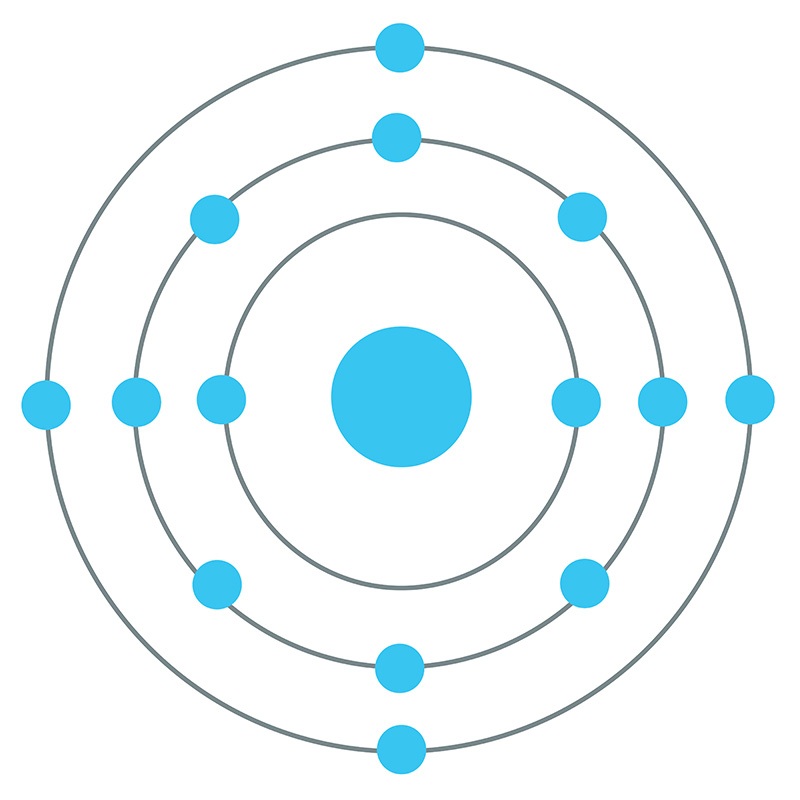
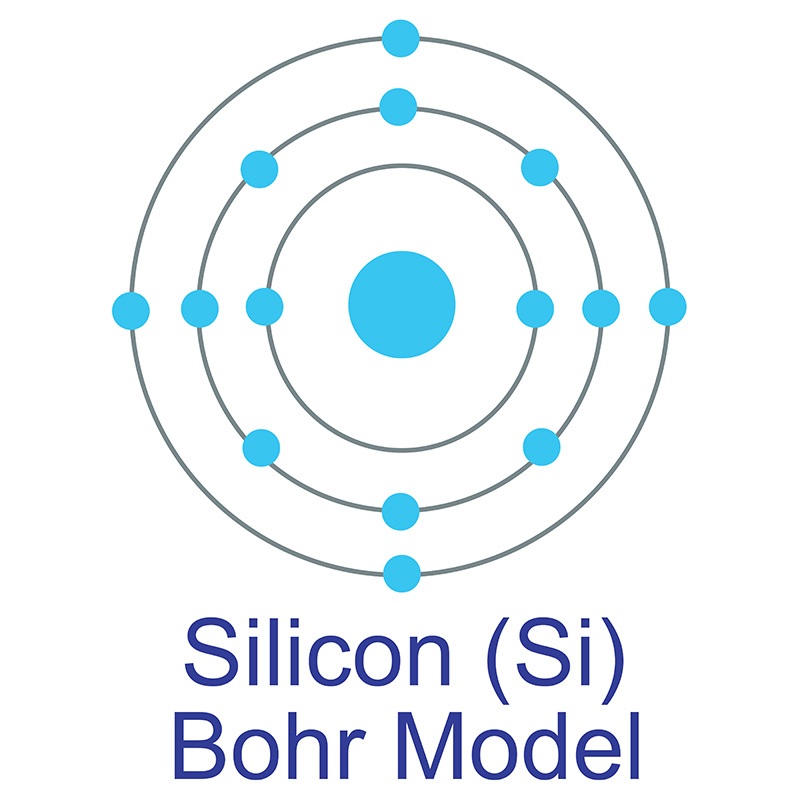
 Silicon is a Block P, Group 14, Period 3 element. The number of electrons in each of Silicon's shells is 2, 8, 4 and its electron configuration is [Ne] 3s2 3p2. The silicon atom has a radius of 111.pm and its Van der Waals radius is 210.pm. In its elemental form, silicon's CAS number is 7440-21-3. Silicon
  makes up 25.7% of the earth's crust, by weight, and is the second most abundant element, exceeded only by oxygen.
 Silicon was discovered and first isolated by Jöns Jacob Berzelius in 1823. It is rarely found in pure crystal form and is usually produced from the iron-silicon alloy Ferrosilicon. The name Silicon originates from the Latin word "silex" which means flint or hard stone.
Health, Safety & Transportation Information for Silicon
Silicon is not toxic but can cause chronic respiratory problems if inhaled as a fine silica or silicate dust. Asbestos silicates are carcinogenic. Safety data for Silicon and its compounds can vary widely depending on the form. For potential hazard information, toxicity, and road, sea and air transportation limitations, such as DOT Hazard Class, DOT Number, EU Number, NFPA Health rating and RTECS Class, please see the specific material or compound referenced in the Products tab. The below information applies to elemental Silicon.
| Safety Data | |
|---|---|
| Signal Word | Warning |
| Hazard Statements | H228 |
| Hazard Codes | F |
| Risk Codes | 11 |
| Safety Precautions | 16-33-36 |
| RTECS Number | VW0400000 |
| Transport Information | UN 1346 4.1/PG 3 |
| WGK Germany | 2 |
| Globally Harmonized System of Classification and Labelling (GHS) |
 |
Silicon Isotopes
Silicon has three stable isotopes: 28Si, 29Si and 30Si.
| Nuclide | Isotopic Mass | Half-Life | Mode of Decay | Nuclear Spin | Magnetic Moment | Binding Energy (MeV) | Natural Abundance (% by atom) |
|---|---|---|---|---|---|---|---|
| 22Si | 22.03453(22)# | 29(2) ms | ß+ to 22Al; ß+ to 21Mg | 0+ | N/A | 130.35 | - |
| 23Si | 23.02552(21)# | 42.3(4) ms | ß+ to 23Al | 3/2+# | N/A | 146.81 | - |
| 24Si | 24.011546(21) | 140(8) ms | ß+ to 24Al; ß+ to 23Mg | 0+ | N/A | 167.93 | - |
| 25Si | 25.004106(11) | 220(3) ms | ß+ to 25Al; ß+ to 24Mg | 5/2+ | N/A | 182.53 | - |
| 26Si | 25.992330(3) | 2.234(13) s | EC to 26Al | 0+ | N/A | 201.79 | - |
| 27Si | 26.98670491(16) | 4.16(2) s | EC to 27Al | 5/2+ | N/A | 215.46 | 92.2297 |
| 28Si | 27.9769265325(19) | STABLE | - | 0+ | 0 | 232.85 | 4.6832 |
| 29Si | 28.976494700(22) | STABLE | - | 1/2+ | -0.55529 | 240.93 | 3.0872 |
| 30Si | 29.97377017(3) | STABLE | - | 0+ | 0 | 251.81 | - |
| 31Si | 30.97536323(4) | 157.3(3) min | ß- to 31P | 3/2+ | N/A | 258.02 | - |
| 32Si | 31.97414808(5) | 132(13) y | ß- to 32P | 0+ | N/A | 267.03 | - |
| 33Si | 32.978000(17) | 6.18(18) s | ß- to 33P | (3/2+) | N/A | 271.38 | - |
| 34Si | 33.978576(15) | 2.77(20) s | ß- to 34P | 0+ | N/A | 279.46 | - |
| 35Si | 34.98458(4) | 780(120) ms | ß- to 35P; ß- + n to 34P | 7/2-# | N/A | 281.95 | - |
| 36Si | 35.98660(13) | 0.45(6) s | ß- to 36P; ß- + n to 35P | 0+ | N/A | 288.17 | - |
| 37Si | 36.99294(18) | 90(60) ms | ß- to 37P; ß- + n to 36P | (7/2-)# | N/A | 290.66 | - |
| 38Si | 37.99563(15) | 90# ms [>1 µs] | ; ß- + n to 37P; ß- to 38P | 0+ | N/A | 295.94 | - |
| 39Si | 39.00207(36) | 47.5(20) ms | ß- to 39P | 7/2-# | N/A | 297.5 | - |
| 40Si | 40.00587(60) | 33.0(10) ms | ß- to 40P | 0+ | N/A | 302.78 | - |
| 41Si | 41.01456(198) | 20.0(25) ms | ß- to 41P | 7/2-# | N/A | 302.48 | - |
| 42Si | 42.01979(54)# | 13(4) ms | ß- to 42P | 0+ | N/A | 305.9 | - |
| 43Si | 43.02866(75)# | 15# ms [>260 ns] | Unknown | 3/2-# | N/A | 305.59 | - |
| 44Si | 44.03526(86)# | 10# ms | Unknown | 0+ | N/A | 307.15 | - |